
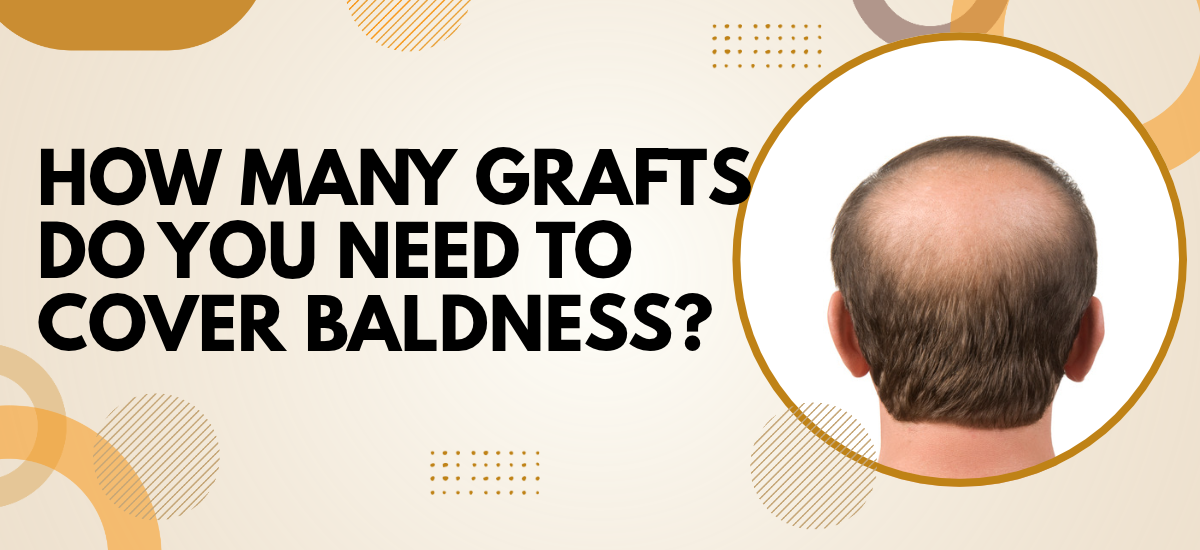
Nobody can hand you one number for how many grafts you need to cover baldness, but surgeons do work with rough ranges. If the hair is only starting to recede, we’re often talking about 500 to 2,000 grafts. Moderate baldness tends to need somewhere between 2,000 and 4,500, and once it’s advanced, 4,000 to 6,000 or even more, which may have to be done in more than one sitting. And a graft isn’t a single hair. It’s a little cluster of one to four, so you end up with about twice as many hairs as grafts.
According to Dr. Monisha Kapoor, aPlastic Surgeon in Saket, Delhi, “Almost every call starts with ‘just tell me the number,’ and I can never do that honestly without looking at the scalp. Two men at the same stage of baldness can need very different numbers, because it depends on how thick their donor hair is and how big the area is. I’d rather plan a number you can cover properly than promise a full head and spread the grafts too thin.”
Hair Transplant Grafts Needed: A Stage-by-Stage Guide
- Early recession (Norwood 2 to 3): somewhere around 500 to 2,000 grafts, mostly to tidy up the hairline and temples.
- Moderate baldness (Norwood 4 to 5): often 2,000 to 4,500 grafts, covering the front and the middle of the scalp, and sometimes the crown as well.
- Advanced baldness (Norwood 6 to 7): 4,000 to 6,000 or more. That’s usually split over sessions, and at stage 7 there often isn’t enough donor hair to cover it all thickly.
- Women: thinning is often more spread out, so the number depends on the area being filled rather than a stage chart.
These are rough ranges, and our Hair Transplant page explains how the scalp and donor area are assessed before a number is given.
Number of Grafts for Hair Transplant: What Changes the Count
- The size of the area. Bigger patch, more grafts. The surgeon measures the bald area and works out the number from the density they’re planning.
- The density you want. Fuller means more grafts, though cramming too many into one spot can stop some of them growing properly.
- Your donor hair. How thick it is, how many hairs each graft carries and how your hair colour contrasts with your scalp all play in. The donor area is limited too, so only a safe part of it gets used.
- Your future hair loss. Baldness usually keeps moving, so a good plan leaves some room for what may happen later on.
Your hairline sits at the top of your forehead, so how the forehead is proportioned affects where the hairline goes, and our Forehead page explains how that’s looked at.
What Makes Your Number Different From Someone Else’s?
- Your stage and pattern of hair loss.
- The size of the thinning patch, measured in square centimetres.
- How much donor hair you’ve got and how thickly it grows.
- What your hair is like: thick or fine, straight or curly, dark against a light scalp or not.
- Your age and how much more hair loss is likely.
Key Takeaways
- A graft is a group of one to four hairs, with two on average.
- Early loss usually needs 500 to 2,000 grafts, while advanced baldness can need 4,000 to 6,000 or more.
- A chart can only give a ballpark. The number of grafts for hair transplant really comes from your area, density and donor hair.
- The donor area is limited, so more grafts isn’t always better.
- A personal number only comes from examining your scalp.
FAQs
- Is a bigger graft count always better?
No. How the grafts are placed and the density used matter as much as the number, and the donor area is limited. Sometimes a smaller number that’s placed well looks better than a big one stretched thin. - Will one session be enough to cover my baldness?
Not always. Smaller areas can often be done in one session, but large areas may need more than one, and in advanced baldness the donor hair may not cover everything at full density. A surgeon should tell you this honestly before you start. - Is a graft the same as a single hair?
No. A graft is a natural group of one to four hairs, with about two on average, so 2,000 grafts means roughly 4,000 hairs, not 2,000. - What if I don’t have enough donor hair?
The surgeon plans around what’s available, usually prioritising the front of the scalp where hair frames the face. In selected cases, hair from other areas such as the beard may be considered, but only after a proper assessment.
References
- Hair Transplantation, StatPearls, PubMed: https://pubmed.ncbi.nlm.nih.gov/31613520/
- Approach to Hair Transplantation in Advanced Grade Baldness by Follicular Unit Extraction, PubMed Central: https://pmc.ncbi.nlm.nih.gov/articles/PMC6967160/
Disclaimer
The information shared in this content is for educational purposes and not for promotional use. Graft numbers are general estimates and vary from person to person. It does not replace a consultation with a qualified doctor.